Alumil: a Snowflake proof of concept with production data
- Client
- Alumil
- Sector
- Aluminium systems manufacturing
- Location
- Kilkis, Greece
- Period
- September to December 2025
- Status
- Proof of concept
- Stack
- Snowflake, Snowpark, Python, XGBoost, Azure Blob Storage, React, Oracle (source)
The situation
Alumil is a Greek maker of aluminium systems for windows, doors and facades. It runs its own extrusion, powder-coating and anodizing plants. Its seat is in the Industrial Area of Stavrochori, Kilkis, and its headquarters and showroom are in Thessaloniki.
On its own site, Alumil says it tests its products along the entire production process, in its own quality control laboratories.
The proof of concept worked with two kinds of production records: extrusion runs and defect records. It looked at whether these records could be brought from the existing source system into Snowflake and analysed together, to see how extrusion data relates to defects.
What we built
We built the proof of concept on Snowflake in four parts, between September and December 2025.
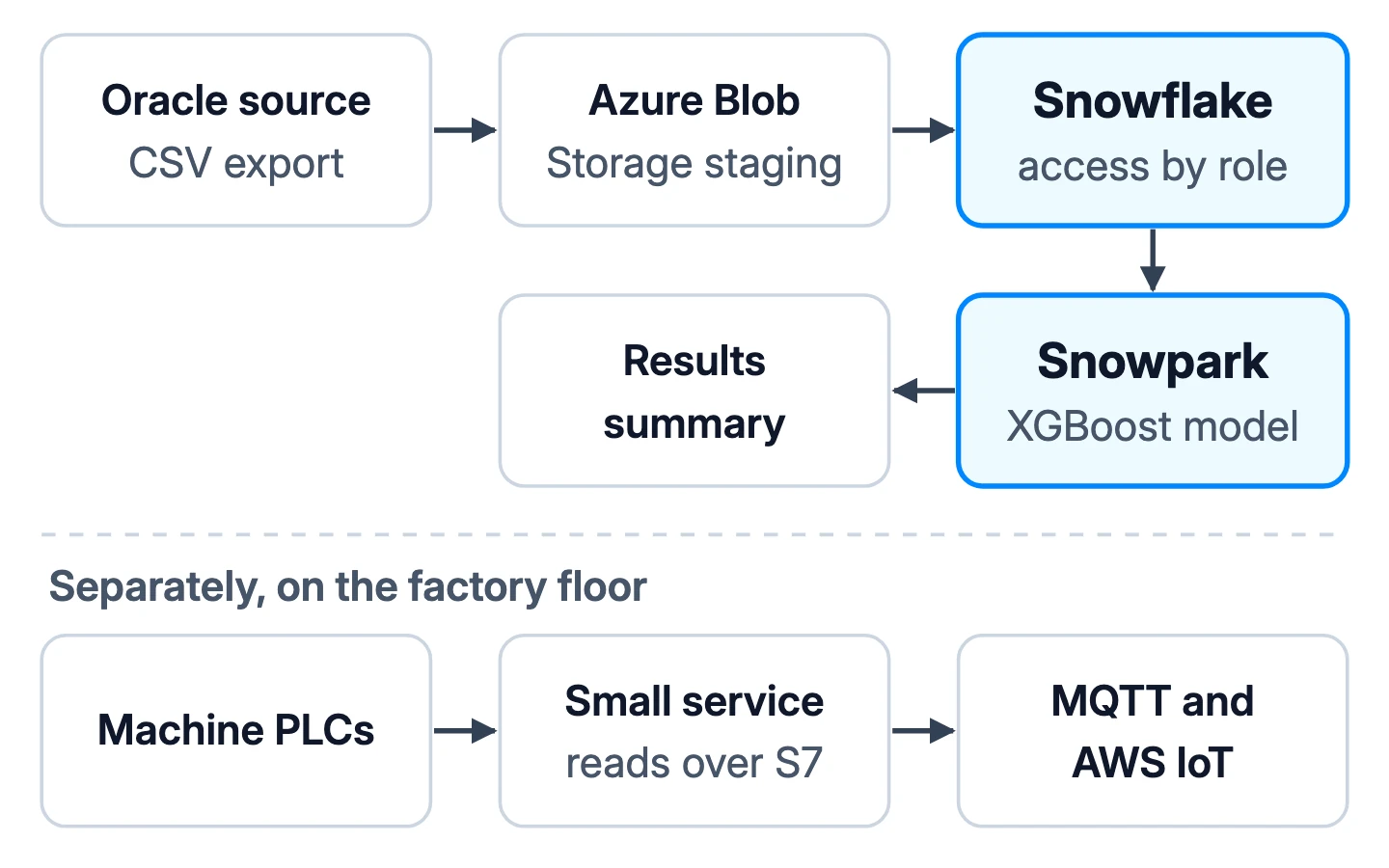
The first part is an extract-and-load pipeline in Python. Production records were exported from the source database, an Oracle system, to CSV files and staged in Azure Blob Storage. From there each file went to the Snowflake table stage that matched its content, extrusion runs or defect records, and was loaded with COPY INTO. Files already loaded were skipped, and the staging area was cleaned up afterwards. We also made a version that runs on dummy data with a local database in Docker, so the whole flow could be shown without any client data.
The second part is the Snowflake workspace itself, set up as code: warehouses, the database and schema, file formats and table stages. Access ran through read-only, read-write and analyst roles, with grants that covered current and future tables.
The third part is the analysis, written in Snowpark with Python, pandas and scikit-learn: an exploratory look at the data, a correlation study, and a multi-output XGBoost regression that relates extrusion features to the defect percentage for each defect code. The model was registered in Snowflake's model registry.
The fourth part is a one-page results summary, built in React with TypeScript, Vite and Tailwind CSS. It sets out the findings, the limits of the data and the next steps.
Separately, a small service ran on a small device on the factory floor. It read data blocks from the machines' PLCs over the S7 protocol, on a heartbeat and on group triggers, and published them over MQTT and AWS IoT. It shipped as a Docker image, with a nightly job that kept it up to date.
The result
The proof of concept ended with three deliverables: production records in Snowflake under role-based access, a first model relating extrusion data to defect percentages, and a one-page summary of findings, data limits and next steps.
The work stayed at the proof of concept stage, and no production rollout or business outcome is on record.
See also
Want something like this built for your business?
Book a free 30-minute callLast updated: