Jupiter: developer relations, SDKs and code examples
- Client
- Jupiter
- Sector
- DeFi platform on Solana
- Period
- February 2025 to November 2025
- Status
- SDKs published on PyPI and crates.io
- Platforms
- Solana, Jupiter APIs
- Stack
- Python, Rust, TypeScript, GitHub Actions
The situation
Jupiter calls itself "the home of onchain finance". It is a DeFi platform on the Solana blockchain for swapping, lending, borrowing, perps, prediction markets and wallets. It also runs developer APIs that other builders call, among them Ultra, Swap, Trigger and Recurring.
When we started in February 2025, Jupiter had no developer relations.
On 24 March 2025, a proposal on the Jupiter Research forum asked for a three-member DevRel Working Group, with Fiji Solutions as its technical lead, to be "the first contact for technical community members and projects". The post credited us with over 1,000 messages in the developer support channel in the previous 30 days. Jupiter's DAO voted for the group, and on 4 April 2025 Jupiter Research reported that it had passed into a three-month trial period.
What we built
Inside the working group, we led the technical work of setting up Jupiter's developer relations. We supported community developers building on Jupiter's APIs.
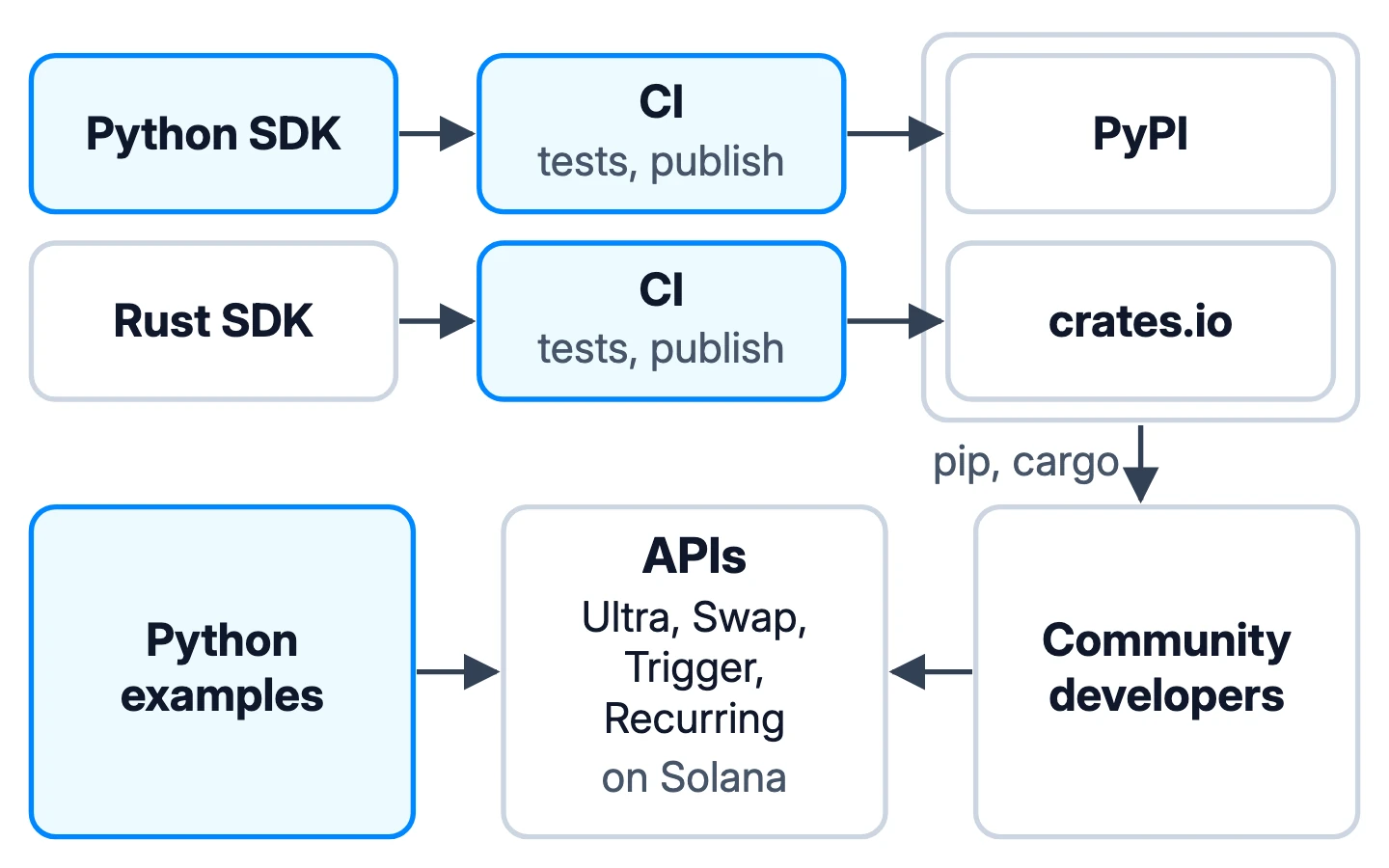
We wrote the official Python SDK for the Jupiter Ultra API. It covers the order, execute, order-and-execute, balances, holdings and shield endpoints, and it accepts a private key in base58 or as a uint8 array. It has typed request models, tests and its own examples. It is written in Python 3.9+ with Poetry, httpx, pydantic, solders and solana. CI runs pytest on every push, a local check script runs black, isort, flake8, mypy and pytest, and a version tag publishes the release to PyPI.
For the Rust SDK, we built the CI and release pipeline in June 2025. It tests the crate, tags new versions automatically and publishes them to crates.io.
We wrote a set of standalone Python examples for the Ultra, Swap, Trigger and Recurring APIs.
We also had changes merged into Jupiter's own code. In its TypeScript client for the quote API, we added API key support in May 2025 and the payer field in the swap request in June 2025. In its documentation, we removed a field that the Ultra order response does not return.
In July 2025, at a Superteam Germany meetup in Berlin, we gave a joint session introducing Jupiter, its DevRel work and its developer tools. We also appeared on podcasts.
The result
The Python SDK is on PyPI. On 25 November 2025, versions 1.1.1 and 1.2.0 added a holdings endpoint and a signing fix, and 1.2.0 is the current version (PyPI, read October 2026). The Rust SDK is on crates.io at version 1.0.6 (crates.io, read October 2026).
Developers who call Jupiter's APIs from Python install the SDK with pip, and Rust developers add the crate with cargo. In August 2025, Jupiter's developer documentation linked the DevRel examples on GitHub.
Where to see it
See also
Want something like this built for your business?
Book a free 30-minute callLast updated: